Chimney guides
Salt Air and Chimneys on the Connecticut Shoreline
A chimney in Old Saybrook and the same chimney twenty miles inland are not doing the same job. Salt is the difference and it works faster than most people expect.
Short answer
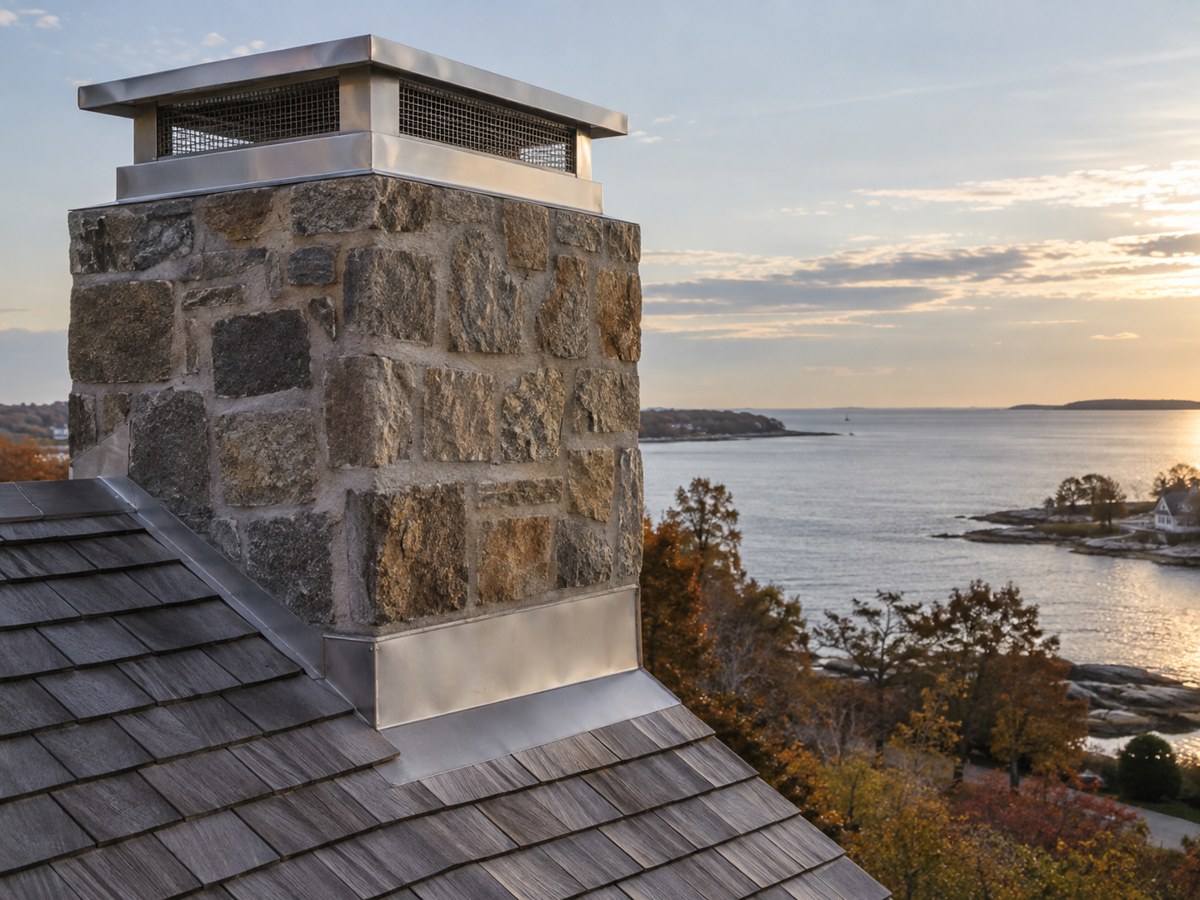
Airborne salt holds moisture against whatever it lands on, so a shoreline chimney stays damp for far longer after rain than an inland one. That consumes the zinc coating on galvanized steel quickly and then takes the steel. It also accelerates mortar loss. The specification that works is stainless throughout — cap, mesh, chase cover and the fixings — plus flashing detailed properly rather than sealed.
What the rust streaks actually are
The most common coastal complaint is orange streaking down the masonry, and the most common misreading of it is that the chimney is failing.
It is nearly always the metal on top of the chimney failing, and the masonry is simply what the runoff lands on. A galvanized cap or a galvanized chase cover within reach of the Sound can be perforating in three or four years. Replacing it stops the staining at source; cleaning the brick without replacing it just resets the clock.
Stainless includes the screws
A stainless cap held on with plated fixings fails at the fixings, and on an exposed stack that means a cap that leaves in the first serious blow. Ask what the fasteners are, not just the cap.
It is specification, not a product
There is no coating that makes a coastal chimney behave like an inland one. What works is choosing materials that do not corrode, and detailing the metalwork so water cannot get behind it.
Why coastal chimneys leak at the flashing
Inland, the commonest chimney leak is a cracked crown. On the shoreline it is the flashing, and the reason is the weather rather than the workmanship.
Wind-driven rain gets under laps and drives up the face of a flashing. A detail that holds perfectly well against vertical rain leaks when rain arrives horizontally off the water — which along the Sound is most of the serious rain. The tell is timing: a flashing leak appears in a blow and often stops in an ordinary shower.
Counter-flashing has to be let in
Cut into a groove in the mortar joint and folded down, not stuck to the surface with sealant. Surface-mounted metal on a coastal chimney has a short life because the sealant is what is holding it.
Seasonal houses have a second problem
A large share of shoreline property is used for part of the year, and a house shut from October to May leaves an unheated chimney standing through the entire wet season.
A cold flue collects condensation continuously with nothing to dry it. That corrodes a metal liner from the inside and keeps the masonry saturated through every freeze. It is also why a spring reopening so often finds nesting and a smell.
What to fit before closing up
A top-sealing damper. It closes the flue at the crown with a silicone gasket, keeps weather out of the whole flue rather than just the firebox, and doubles as the rain cap. On a seasonal property it is the single most useful thing to have.
Book the inspection for spring
Not for the first cold evening you want a fire. Nesting, debris and moisture damage accumulate through an unattended winter, and the first fire is the worst moment to discover any of it.
Need this done?
Coastal Chimney Protection across Connecticut
Free to use, no obligation — we never charge you.
Frequently asked questions
How far inland does salt actually reach?
Further than most people expect — corrosion rates stay elevated well back from the water, and storms carry salt further still. Anywhere in the shoreline towns, specify stainless.
Is stainless worth the extra cost?
Near salt water it is not really a choice. Galvanized may give you three to five years there against decades for stainless, and the labor to fit either is identical.
Should I waterproof a coastal chimney?
On sound masonry, yes, with a breathable repellent. On brick that has already started to spall it traps water and makes things worse. And on genuinely old soft brick along the shoreline, the honest answer is often to fix the water source and leave the masonry alone.
Chimney services near you
- Bridgeport
- New Haven
- Stamford
- Hartford
- Waterbury
- Norwalk
- Danbury
- New Britain
- West Hartford
- Meriden
- Bristol
- Hamden
- Milford
- Stratford
- Middletown
- West Haven
- East Hartford
- Fairfield
- Wallingford
- Norwich